
Dormancy
A mature, live seed, which will not germinate promptly when placed under suitable conditions, is said to be dormant.
The mechanisms that prevent germination vary widely and it is not necessary to understand them to grow trees from seed successfully. What is important for us to understand is how we can get these dormant seeds to germinate.
Overcoming dormancy
Relatively simple and effective methods exist to overcome the dormancy of our tree and shrub seeds.
The most common requirements are exposure to periods of warmth and/or cold.
The simplest method of providing these conditions is to place the seeds outdoors, mixed with a moisture retentive and aerated medium (usually a sand/compost mixture).
Seed pretreatment
In order to be successfully treated seeds must be moist. Seeds that are placed into treatment immediately following extraction will require no further processing.
Seeds that have been stored for any length of time will require soaking in water for 24-48 hours. Soaking dried seeds performs two functions. Firstly, the seeds take up water and, secondly, some of the germination inhibitors in the seed coat are removed.
| Species | Scientific name | Collection month(s) | Can seed be stored | Dormancy type | Pretreatment |
|---|---|---|---|---|---|
| Alder | Alnus glutinosa | October–November | Yes, dries and stores | Shallow dormancy | Fridge, 4 weeks |
| Ash | Fraxinus excelsior | September–October | Yes, dries and stores | Moderate dormancy | Outdoor sand plunge, 18 months |
| Bird Cherry | Prunus padus | August | Yes, dries and stores | Moderate dormancy | Warm ~2–4 weeks + cold ~18 weeks (roughly 5 months) |
| Blackthorn | Prunus spinosa | September–October | Yes, dries and stores | Moderate dormancy | Warm ~2 weeks + cold ~18 weeks (roughly 5 months) |
| Crab Apple | Malus sylvestris | September–October | Yes, dries and stores | Shallow dormancy | Cold, ~14 weeks (roughly 3–4 months) |
| Dog rose | Rosa canina | October | Yes, dries and stores | Hard coated and deeply dormant | Outdoor sand plunge, 18 months |
| Downy Birch | Betula pubescens | August–September | Yes, dries and stores | Shallow dormancy | Fridge, ~4 weeks |
| Elder | Sambucus nigra | September | Yes, dries and stores | Moderate dormancy | Outdoor sand plunge over one winter (roughly 5–6 months) |
| Field maple | Acer campestre | August–October | Yes, dries and stores | Moderate dormancy | Outdoor sand plunge, 18 months (none needed if collected green) |
| Goat Willow | Salix caprea | May–June | No — sow fresh | None | None — sow within a day or two of collection |
| Gorse | Ulex europaeus | July–August | Yes, dries and stores | Hard seed coat | Boiling water poured over, left to cool 24 hours |
| Grey Willow | Salix cinerea | May–June | No — sow fresh | None | None — sow within a day or two of collection |
| Guelder Rose | Viburnum opulus | October | Yes, dries and stores | Moderate dormancy | Warm ~8–12 weeks + cold ~8–12 weeks (roughly 4–6 months) |
| Hawthorn | Crataegus monogyna | October | Yes, dries and stores | Moderate dormancy | Outdoor sand plunge, 18 months |
| Hazel | Corylus avellana | September | Yes, dries and stores | Shallow dormancy | Cold, ~12–16 weeks (roughly 3–4 months) |
| Holly | Ilex aquifolium | November–December | Yes, dries and stores | Deep dormancy | Warm ~40 weeks + cold ~24 weeks (over a year in total) |
| Juniper | Juniperus communis | September–December | Yes, dries and stores | Deep dormancy | Outdoor sand plunge, at least 6 months |
| Pedunculate Oak | Quercus robur | September–October | No — sow fresh | None | None — sow as soon as possible, doesn’t tolerate drying |
| Sessile Oak | Quercus petraea | October | No — sow fresh | None | None — sow as soon as possible, doesn’t tolerate drying |
| Rowan, Mountain Ash | Sorbus aucuparia | August–September | Yes, dries and stores | Moderate dormancy | Warm ~2 weeks + cold ~14–16 weeks (roughly 4 months) |
| Scots Pine | Pinus sylvestris | September–December | Yes, dries and stores | Shallow dormancy | Cold, a few weeks |
| Silver Birch | Betula pendula | August–September | Yes, dries and stores | Shallow dormancy | Fridge, 4 weeks |
| Spindle | Euonymus europaeus | October | Yes, dries and stores | Moderate dormancy | Warm ~8–12 weeks + cold ~8–16 weeks (roughly 4–7 months) |
| Wild Cherry | Prunus avium | July | Yes, dries and stores | Moderate dormancy | Warm ~2 weeks + cold ~18 weeks (roughly 5 months) |
| Wych Elm | Ulmus glabra | May–June | No — sow fresh | None | None — sow as soon as possible after collection |
| Yew | Taxus baccata | August–September | Yes, dries and stores | Deep dormancy | Outdoor sand plunge, a couple of winters (sometimes three) |
‘Stratification’ method (warm and/or cold)
Seeds of most species should be mixed with a moisture retentive and aerated medium in a 50:50 ratio of seeds and mixture by volume. The ideal mixture is 50% coarse, sieved peat-alternative and 50% coarse sand.
The mixture should be moist but not waterlogged. Water is added to the dry ingredients, thoroughly mixed and tested by squeezing a handful. When only one drop of liquid can be squeezed out between the fingers then the mixture is ready. This ensures that the seeds remain moist throughout the treatment period, but the exchange of gases (oxygen and carbon dioxide) is not inhibited.
The seeds and/or mixture are placed in a suitable container. Ordinary plant pots (with a layer of sand above and below the seed/compost mixture) are fine.
Seeds of alder and birch can be stratified ‘naked’ (i.e. without the medium). The seeds are placed in cotton bags and soaked in cold water for 48 hours. After a superficial drying, they are placed in polythene bags, which are loosely tied and placed into the fridge for four to eight weeks.
Hot-water treatment
For broom and gorse seeds, a slightly different approach is needed. The procedure is not complicated, but a little unusual.
The seeds will have been collected and stored dry. Just before sowing, the seeds are placed in a heatproof container and two or three times their volume of boiling water is carefully poured over them.
They are left in the cooling water for another 24 hours. They are then ready for sowing.
Non-dormant seeds (requiring no treatment)
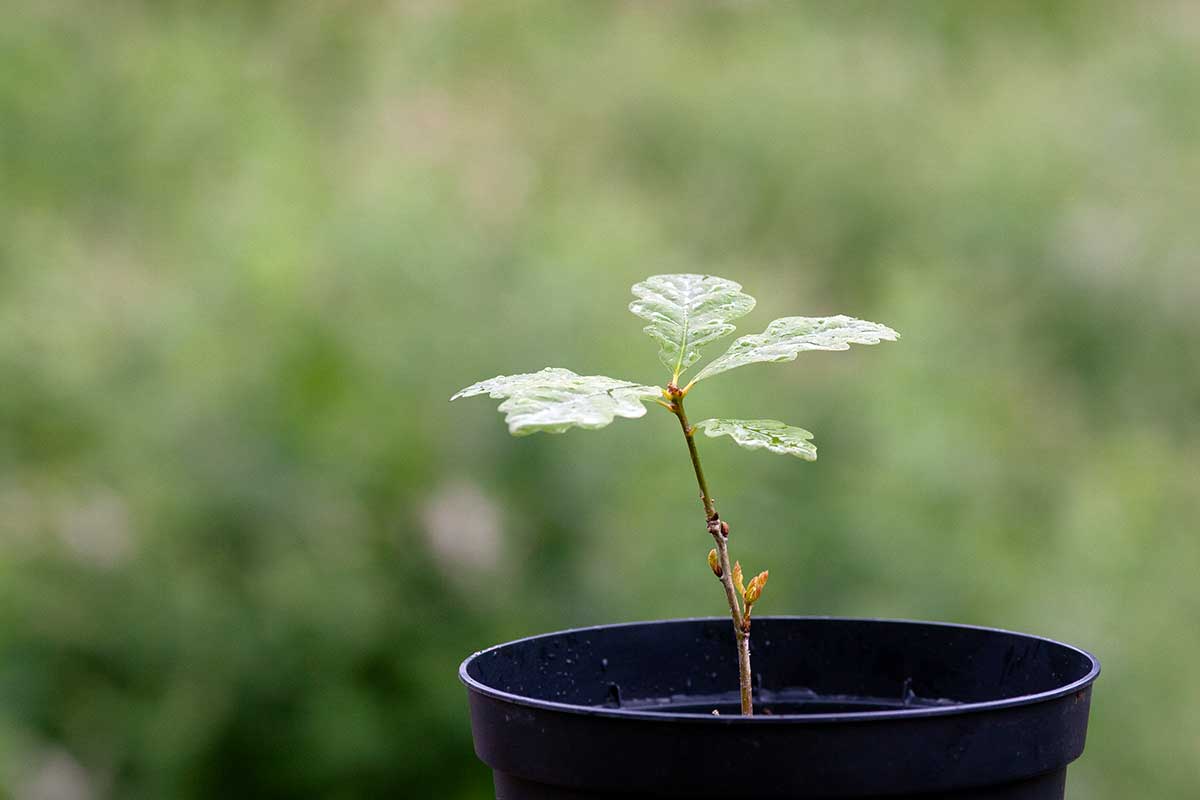
Both of our oak species fall into this category. The main problem with these seeds is not how to break their dormancy, but how to stop them from germinating before you want them to!
The best thing to do with these seeds is to sow them as soon as possible after collection (preferably immediately) and then to let nature take its course.